Recovery
 GOD POWER
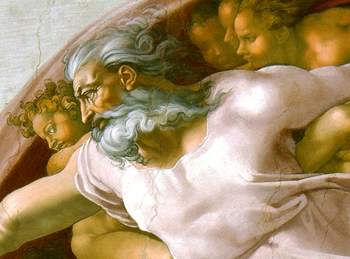
This just in - failth and spirituality work.
by John McManamy
GOD POWER
This just in - failth and spirituality work.
by John McManamy
JESUS ASKED him, ‘What is your name?’ ‘Legion,’ he replied. This was because so many devils had taken possession of him. ... the devils came out of the man and went in to the pigs, and the herd rushed over the edge of the lake and were drowned. ... The spectators told them how the mad-man had been cured." (Luke 8.30 - 37.)
Jesus is savior to many, and known as a healer to all, many who pray to him or a veritable pantheon of saints for release from their physical and mental afflictions. The power of spiritual healing is not confined to Christianity. The great Jewish prophet Elijah was also a healer, and the faith has a long tradition of nabi’im who have performed miracles.
One of the best-known Buddhist parables involves the Buddha refusing to use his power to heal in order to teach the lesson of acceptance, though the Mahayana branch of the faith as practiced by the Tibetans parallels Catholicism in its belief in the healing power of holy objects and petitions to saints. The mind-body movement of Deepak Chopra is grounded in Hindu ayurvedic medicine, and modern spiritual practices, among other things, draw from shamanic and other ancient traditions.
Spiritual and Religious Practice
The scientific revolution was more about how our changing conceptions of our relationship to God rather than in the denial of faith. We may be far more skeptical, but we don't rule out possibilities. As of 2001 (when I first wrote this) , there have been about 1,200 studies on the healing power of faith and the health effects of spirituality, according to Dr Harold Koenig, founder of the Center for the Study of Religion/Spirituality at Duke University. Five studies he has been involved in include:
- A 1998 study of nearly 4,000 people aged 65 years and older which found the risk of diastolic hypertension 40 percent lower among people who attended religious services at least once a week and prayed or studied the Bible at least daily.
- A 1997 study of more than 1,700 older adults from North Carolina which found that persons who attended church at least once a week were only half as likely as non-attenders to have elevated levels of interleukin-6, an immune system protein involved in a wide variety of age-related diseases.
- A 1998 study of 87 depressed older adults which found those who recovered from depression the fastest corresponded to the extent of their religious belief.
- A study of 542 patients aged 60 or older admitted to Duke University Medical Center which found those who attended religious services weekly or more reduced hospital stays by more than half. People with no religious affiliation spent an average of 25 days in the hospital compared to 11 days for patients affiliated with some religious denomination.
- Patients who attended religious services weekly or more also were 43 percent less likely to have been hospitalized in the previous year. A 2002 study of 116 depressed geriatric patients who were given standard medications treatment over 12 weeks. The recovered patients in the study reported "significantly more frequent public and private religious practices, greater positive religious coping, and less negative religious coping" than those who remained depressed.
The National Institute of Health Care Research, which listed four of these Duke studies, also included:
- A 1995 study of 232 patients at Dartmouth Medical School which found that elderly heart patients were 14 times less likely to die following surgery if they found strength and comfort in their religious faith and remained socially involved.
- A landmark University of California at Berkeley study that followed 5,286 people from Alameda County, California over 28 years, which found those who attended religious services weekly or more were 25 percent less likely to die than infrequent attenders.
- A 1998 study of 2,025 senior citizens in Marin County, California which found attending worship services on a regular basis was an important factor in predicting longevity.
- A 1999 study tracking more than 21,000 US adults which found attending religious services more than once a week can expand one’s life up to seven years and added a potential 14 more years to the life span of African Americans.




In 2001, Dr Koenig, along with fellow Duke scientist, David Larson MD, MSPH, and Michael McCullough PhD of Southern Methodist University, published "Handbook for Religion and Health" (Oxford University Press). In preparing the book for publication, the authors reviewed more than 100 studies on the relationship of religion to depression. Two-thirds of those studies found religious persons have less depression than those who are non-religious, and if they become depressed, they recover more quickly.
A review of 12 studies by Dr Larson et al published in the Journal of Psychology and Theology in 1991 found a positive relationship between religious commitment and lower suicide rates. A study by Nisbet et al published in the Journal of Nervous and Mental Disorders in 2000 found that adults 50 years or older who never participated in religious activities were four times more likely than religious people in their age group to commit suicide, replicating the results of a 1972 study.
SIGN UP FOR MY FREE EMAIL NEWSLETTER
Skeptics cite the placebo effect as a probable cause of the benefits of spiritual belief, together with the fact that religious communities offer the kind of support networks that reduce stress and ease mental anguish. Additionally, those who attend religious services have better health habits, such as drinking and smoking less. Finally, religions encourage marriage, which is a reliable predictor of longer life.
But the true cause of the healing effect hardly matters. In an interview in the Winter 2002 issue of Health and Spirituality Connection, Dr Koenig explained that religion gives people hope and optimism and helps them better overcome a negative life experience. Some religious people may think God is punishing them or become overburdened with guilt, but religion can also relieve guilt and grant forgiveness.

An Interesting Little Sidebar
A 2001 Italian study published in the British Medical Journal found that reciting the Ave Maria or chanting a Hindu mantra six times a minute "enhances and synchronizes ... cardiovascular rhythms" by slowing respiration to the same timing as circulatory rhythms, creating a feeling of well being. The Ave Maria is recited 50 times in the rosary. The priest recites "Ave Maria, gratia plena, Dominus tecum, benedicta tui mulieribus et benedictus fructus ventris tui Jesus", and the congregation answers: "Sancta Maria, Mater Dei, ora pro nobis peccatoribus, nunc et in hora mortis nostrae, Amen." Both the Ave Maria and the Hindu mantra, "Om mani padme om," each take about ten seconds to recite.
According to the study’s authors: "The rosary was introduced to Europe by the crusaders, who took it from the Arabs, who in turn took it from Tibetan monks and the yoga masters of India. This supports the hypothesis that the similar characteristics and effects of these mantras and of the rosary may not be a simple coincidence."
Conclusion
Even though no one is certain how spiritual practice aids in recovery, it is apparent that a number of processes in the body are being enlisted in the cause, from the brain’s relaxation response to the release of hormones to the strengthening of the body’s immune system. A Yankelovich survey found 94 percent of HMO professionals and 99 percent of family physicians agreeing that personal prayer can enhance medical treatment. More surprising, 75 percent of the family physicians believed that prayers of others could promote a patient's recovery.
A Gallup Poll found 95 percent of those in the US believe in God or a Universal Spirit. In addition, 85 percent of Americans consider religion "very important" or "fairly important" in their lives. A 1997 survey found 80 percent of psychiatric inpatients consider themselves spiritual or religious persons, with 68 percent relying on religion as a source of strength "a great deal."
Of 125 medical schools in the US, most now require spirituality and healing classes for graduation or as a component of a required class. In 1994, only four medical schools offered these classes. This is a far cry from the legacy of Freud, who described religious beliefs as a mass delusion and the Catholic faith as the enemy. As recently as the 1990s, the DSM-III-R used religious behavior in 23 percent of its examples of psychopathology
According to Dr Herbert Benson, president of the Mind/Body Medical Institute of Boston's Deaconess Hospital and Harvard Medical School, cited in a 1996 Time cover story: "Anywhere from 60 percent to 90 percent of visits to doctors are in the mind-body, stress-related realm."
In his book Timeless Healing, Benson contends that humans are actually engineered for religious faith: "Our genetic blueprint has made believing in an Infinite Absolute part of our nature."
You don’t have to believe in a higher power to benefit from religion or spirituality. God won't mind if you join a religious congregation for the bingo.Meditation and yoga is very atheist-friendly, and many religious works and services can evoke a strong inner response without the necessity of theological correctness.
As well as attending services, a good daily practice is recommended. This can range from a five-minute Bible reading to an hour-long meditation. It is helpful to abide by a strict schedule and set aside a certain part of the house, lighting candles or incense, if necessary, to set the mood. If you have bipolar, bear in mind you are capable of inspiring yourself into a state of mania, and that retreats or seminars that have an all-night component should raise the yellow caution flag with you.
Finally, remember that spiritual practice should be regarded as a complement rather than a substitute for proper medical care. A 1998 University of California study reviewed the medical records of 172 children who died after their parents relied on faith healing instead of standard medicine. The majority of these children would have survived if they had received normal medical care.
Reviewed July 10, 2016
VIDEO
NEW!
Follow me on the road. Check out my New Heart, New Start blog.