Famous People
 VIRGINIA WOOLF AND HER MADNESS
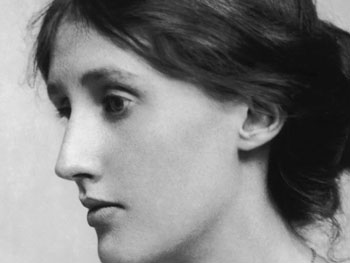
The thought of going under one more time was more than she could take.
by John McManamy
VIRGINIA WOOLF AND HER MADNESSThe thought of going under one more time was more than she could take.
by John McManamy
A TELEGRAM ARRIVED at the HMS Dreadnought, the flagship of the British home fleet, advising the Admiral of a visit by the Emperor of Abyssinia and four of his entourage. The dignitaries were given the red carpet treatment and the visit went off without a hitch, except for the fact that the real Emperor happened to be back in Addis Ababa. One of the "Abyssinians", decked out in flowing robes and dark greasepaint, turned out to be a youthful Virginia Woolf.
The media and political storm that broke out in the wake of the hoax did little for Virginia's mental equilibrium. She had already experienced one breakdown and was well on her way toward another. All her life that beast/companion we know as manic depression would stalk both her and her family, and finally claim her. One cold day in 1941 - her body wasting from neglect, her thoughts racing, and hearing voices - she wrote:
I feel certain now that I am going mad again. I feel we can't go through another of those terrible times. And I shan't recover this time ...
Then she walked down to the river bank, filled her pockets with stones, and left her walking stick on the ground. Children would discover her body three weeks later. Following an inquest, the verdict was announced as: "Suicide while the balance of her mind was disturbed."
Virginia Woolf has no shortage of chroniclers, many who know far more about literature than they do about mental illness. Her childhood traumas, sexual frigidity, and lesbian flirtations may have been the stuff of Freudian psychodrama, but it was the storm and fury of bipolar that truly governed her life. In any event, only one biography appears to have tackled her madness head on, "The Marriage of Heaven and Hell: Manic Depression and the Life of Virginia Woolf" by Peter Dally (1999).
The title pretty much says it all. According to Dally, who is a psychiatrist: "Virginia's need to write was, among other things, to make sense out of mental chaos and gain control of madness. Through her novels she made her inner world less frightening. Writing was often agony but it provided the 'strongest pleasure' she knew."
SIGN UP FOR MY FREE EMAIL NEWSLETTER
The Bloomsbury crowd and the literary highlife fed her hypomanic surges, but it was from the depths of depression that she seemed to dredge up her best inspiration. When she started a novel, according to Dally, she was excited but relaxed and stable, only succumbing to exhaustion and depression in the revision stages.
Her husband, Leonard Woolf described her early stages of mania:
She talked almost without stopping for 2 or 3 days, paying no attention to anyone in the room or anything said to her ... Then gradually it became completely incoherent, a mere jumble of dissociated words.
In full flight of madness, according to Dally, "birds spoke to her in Greek, her dead mother materialized and harangued her, voices called her to 'do wild things.' She refused nourishment. Trusted companions like her husband Leonard and her sister Vanessa became enemies and were abused and assaulted ... "
Fortunately, her friends and family tolerated her and took care of her. Had she been born into a different class or with a less understanding family, she undoubtedly would have been locked away for life. As it was, lengthy asylum stays were a fact of life for her, as were long recuperative periods spent at home.
Her first breakdown occurred at age 13, shortly following the death of her mother. Several breakdowns later, at age 31, she entered a severe depression in which she made an attempt on her life by swallowing 100 grains of Veronal. Only the serendipitous presence of a distinguished physician in nearby lodgings saved her life. He pumped out her stomach and stayed with her throughout the night.
The suicide attempt was part of two back-to-back breakdown/recuperations lasting the better part of two years. Fierce, though decidedly less lethal, mood swings would continue to dog her the rest of her life. One night, in 1921, she went to a concert and stayed up all night, only to take to her bed for the next eight weeks.
"What a gap!" she recorded in her diary. "How it would have astounded me to be told when I wrote the last word here, on June 7th, that within a week I [should] be in bed, and not entirely out of it till the 6th of August - two whole months rubbed out .."
Husband Leonard acted as her protector, seeing her through the depressions and nipping some of her manic surges in the bud: "I am alive; rather energetic," Virginia wrote in her diary. "But half the horror is that [Leonard] instead of being, as I gathered, sympathetic has the old rigid obstacle - my health."
By 1935, when she was working on "The Years", the constant cycle of mania and depression was beginning to overtake her. The revision was particularly difficult, and in 1936 she wrote to a friend:
...never trust a letter of mine not to exaggerate that's written after a night lying awake looking at a bottle of chloral and saying, No, no no, you shall not take it. It's odd how sleeplessness, even of a modified kind, has the power to frighten me. It's connected I think with these awful times when I couldn't control myself.
She took time off to ride out the depression, only to throw herself into her next work, "Three Guineas", which "pressed and spurted out ... like a physical volcano."
There would be one more novel after that, "Between the Acts", then the writing would cease. Husband Leonard was struggling with his own depression, leaving Virginia to fend for herself. The timing could not have been worse. England at the time was on the losing end of the Second World War, and Virginia was isolated in the south of England, away from her usual circle of friends. The beast/companion was literally eating her alive, and in the end, in the only way she knew how, she decided to stop the madness.
Reviewed July 15, 2016
NEW!
Follow me on the road. Check out my New Heart, New Start blog.



MORE ARTICLES ON McMAN


FEATURED VIDEOS